


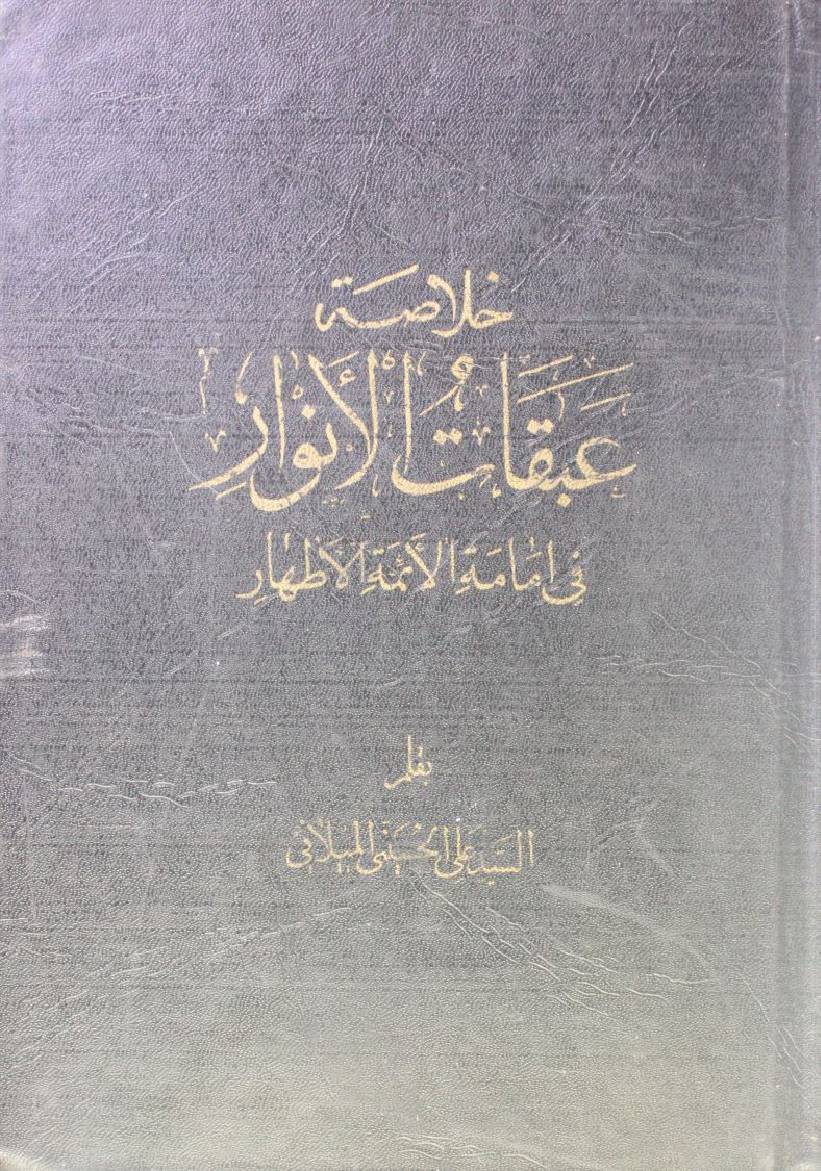
Abqat Al Anwar fi immamat al Aaima athaar (Hadees al Thaqalain 3)
Sayyid Hamid Husayn and his work ‘Abaqat al Anwar" have been held in great esteem amongst leading Shi’i scholars.Abaqat al-Anwar is not only a greatest work on Imamat ever written but also perhaps as one of the greatest masterpieces of scholarship ever compiled. Sayyid Hamid Husayn wrote his book in two sections, the first concerning the Qur'anic basis of Imamate and the second concerning its basis in the Prophet's hadith. The first section has not been published. The second section consists of 12 parts, each of which deals with the sanad (chains of transmission) and the meaning (dalalah) of one of the twelve traditions of the Prophet (S) concerning ‘Ali ibn Abi Talib (A) or the Ahlul Bayt (A) rejected by Shah ‘Abd al-Aziz as supporting the doctrine of Imamate. The published parts of ‘Abaqat deal with eight of these traditions, each part dealing with the sanad and doctrinal import of one of them. Sayyid Hamid Husayn's approach in each of these parts is to show that the hadith is a mutawatir one, having been narrated by Sunni traditionists of every generation from the time of the Companions to the scholars of his own era. He devotes a section to each of the narrators, quotes the tradition as narrated by him, and cites the opinions of biographers and Sunni authorities of ‘ilm al-rijal regarding his reliability, trustworthiness and his scholarly station.
Published By:
Published Date:
June 15, 2026
Pages:
448
Subjects:
Available Format:
(42.87)
Action:
Description
Sayyid Hamid Husayn and his work ‘Abaqat al Anwar" have been held in great esteem amongst leading Shi’i scholars.Abaqat al-Anwar is not only a greatest work on Imamat ever written but also perhaps as one of the greatest masterpieces of scholarship ever compiled. Sayyid Hamid Husayn wrote his book in two sections, the first concerning the Qur'anic basis of Imamate and the second concerning its basis in the Prophet's hadith. The first section has not been published. The second section consists of 12 parts, each of which deals with the sanad (chains of transmission) and the meaning (dalalah) of one of the twelve traditions of the Prophet (S) concerning ‘Ali ibn Abi Talib (A) or the Ahlul Bayt (A) rejected by Shah ‘Abd al-Aziz as supporting the doctrine of Imamate. The published parts of ‘Abaqat deal with eight of these traditions, each part dealing with the sanad and doctrinal import of one of them. Sayyid Hamid Husayn's approach in each of these parts is to show that the hadith is a mutawatir one, having been narrated by Sunni traditionists of every generation from the time of the Companions to the scholars of his own era. He devotes a section to each of the narrators, quotes the tradition as narrated by him, and cites the opinions of biographers and Sunni authorities of ‘ilm al-rijal regarding his reliability, trustworthiness and his scholarly station.