


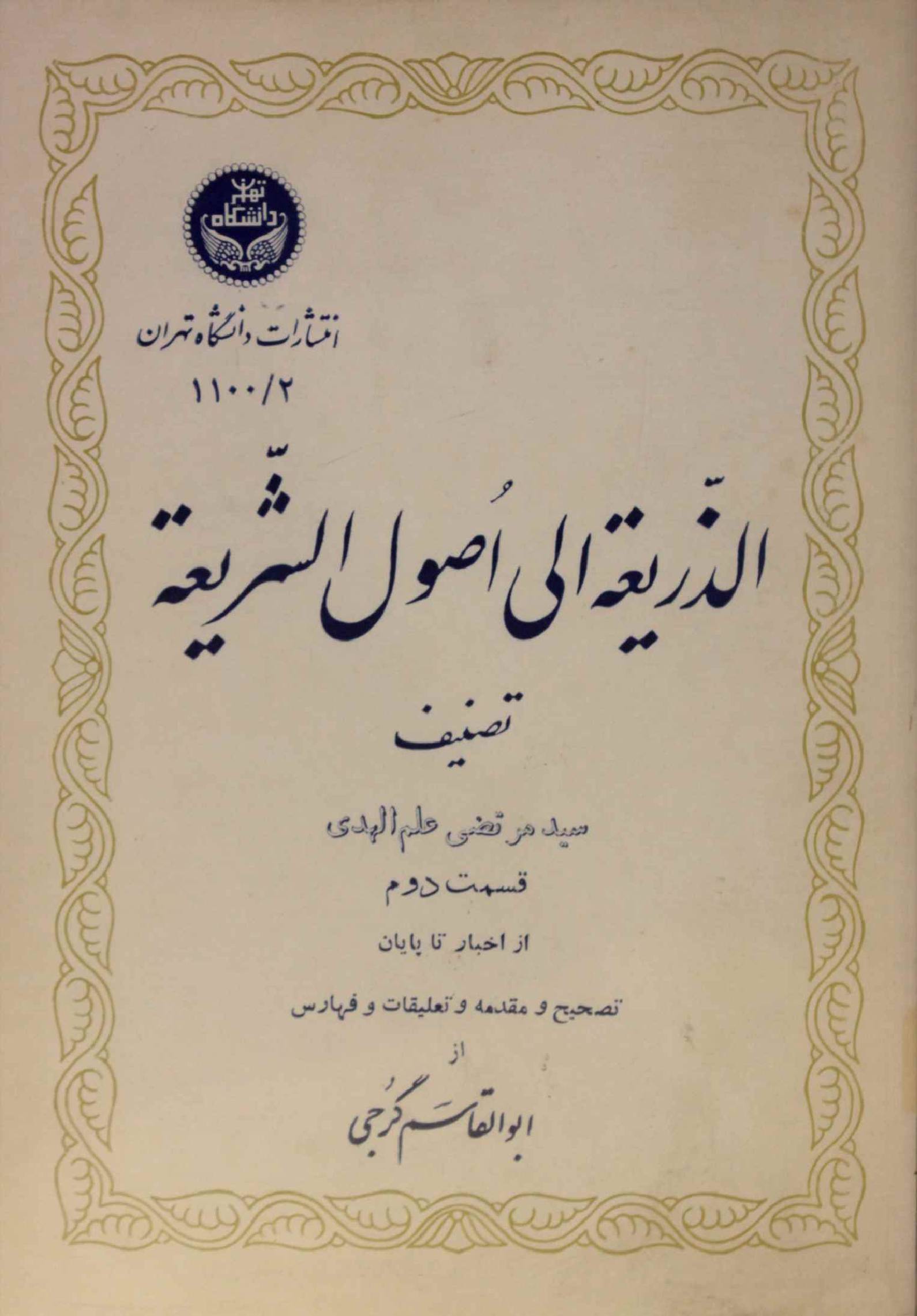
Dhari'a ila usul al Sharia volume 2
Sayyid Murtada was a renowned Iraqi scholar and one of the greatest Shi'a scholars of his time. A student of Shaykh al-Mufīd, he played a pivotal role in shaping Shi'a scholarship and trained eminent figures like Shaykh al-Tūsī. He excelled in kalam (theology), fiqh (jurisprudence), usul al-fiqh (principles of jurisprudence), literature, grammar, and poetry. Sayyid Murtada's book *Dhari'a ila Usul al-Shari'a* is one of the most important works on *usul al-fiqh* (principles of Islamic jurisprudence) in Shi'a scholarship. It systematically explores the foundations of legal reasoning, the methodology of deriving Islamic rulings, and the intellectual framework that guides jurisprudential analysis. The book delves into key topics such as the role of certainty (*qatʿ*) and conjecture (*zann*) in legal judgments, the authority of the Qur'an and hadith, the validity of consensus (*ijmaʿ*), and the principle of *istishab* (presumption of continuity). It also discusses *taʿadul wa tarajih* (methods for resolving conflicting evidences), outlining how scholars should prioritize legal sources when discrepancies arise. This work had a lasting impact on Shi'a jurisprudence, influencing later scholars and shaping the development of legal thought in the Islamic world. It remains a cornerstone reference for students and experts in *usul al-fiqh*, demonstrating Sayyid Murtada's intellectual depth and his contributions to Islamic legal theory.
Published By:
Published Date:
June 15, 2026
Pages:
559
Subjects:
Available Format:
(78.02)
Action:
Description
Sayyid Murtada was a renowned Iraqi scholar and one of the greatest Shi'a scholars of his time. A student of Shaykh al-Mufīd, he played a pivotal role in shaping Shi'a scholarship and trained eminent figures like Shaykh al-Tūsī. He excelled in kalam (theology), fiqh (jurisprudence), usul al-fiqh (principles of jurisprudence), literature, grammar, and poetry. Sayyid Murtada's book *Dhari'a ila Usul al-Shari'a* is one of the most important works on *usul al-fiqh* (principles of Islamic jurisprudence) in Shi'a scholarship. It systematically explores the foundations of legal reasoning, the methodology of deriving Islamic rulings, and the intellectual framework that guides jurisprudential analysis. The book delves into key topics such as the role of certainty (*qatʿ*) and conjecture (*zann*) in legal judgments, the authority of the Qur'an and hadith, the validity of consensus (*ijmaʿ*), and the principle of *istishab* (presumption of continuity). It also discusses *taʿadul wa tarajih* (methods for resolving conflicting evidences), outlining how scholars should prioritize legal sources when discrepancies arise. This work had a lasting impact on Shi'a jurisprudence, influencing later scholars and shaping the development of legal thought in the Islamic world. It remains a cornerstone reference for students and experts in *usul al-fiqh*, demonstrating Sayyid Murtada's intellectual depth and his contributions to Islamic legal theory.