

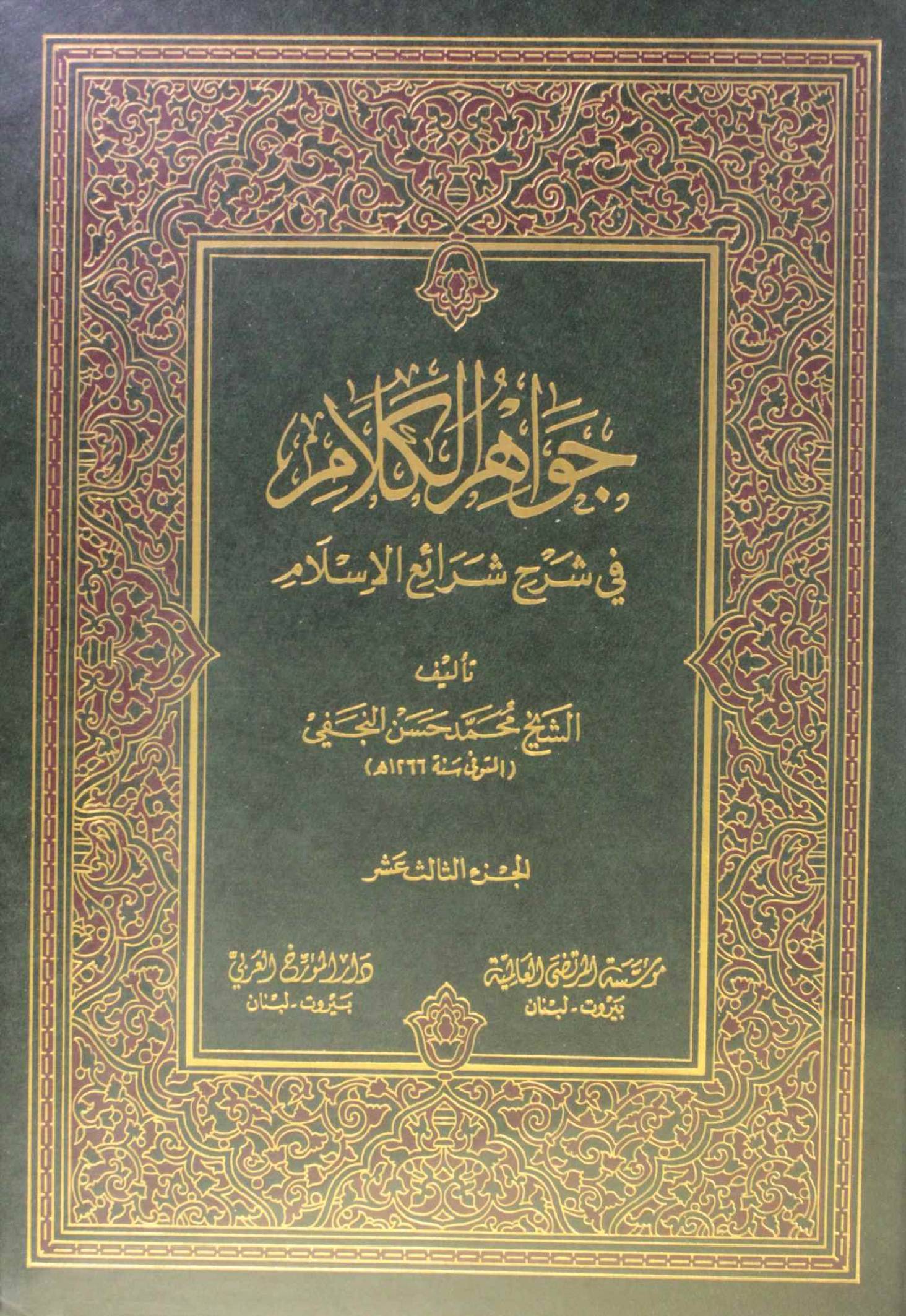
Jawahir Al kalam volume 13
Jawāhir al-kalām fi sharh sharāʾiʿ al-islām commonly known as Jawāhir al-kalām is a book concerning demonstrative fiqh by Muhammad Hasan al-Najafi who has come to be known as Sahib Jawahir (the author of Jawahir) (d. 1266/1850), a student of Sayyid Muhammad Jawad 'Amili and Shaykh Ja'far Kashif al-Ghita. The book is an extended exposition of Shara'i' al-Islam by al-Muhaqqiq al-Hilli (d. 676/1277). It is unique in its details providing researchers with views and arguments of past scholars of jurisprudence. Jawahir al-kalam is a comprehensive and discursive work in Imamiyya jurisprudence. The organization of the chapters of the book is the same as that of Shara'i'—it contains 4 general parts: 'ibadat (worships), 'uqud (contracts), 'iqa'at (unilateral obligations), ahkam (rulings). After it was written, Jawahir al-kalam attracted the attentions of Shiite scholars, both because of the character of its author and because of the unique features of the book itself.
Published By:
Published Date:
June 15, 2026
Pages:
751
Subjects:
Available Format:
(133.83)
Action:
Description
Jawāhir al-kalām fi sharh sharāʾiʿ al-islām commonly known as Jawāhir al-kalām is a book concerning demonstrative fiqh by Muhammad Hasan al-Najafi who has come to be known as Sahib Jawahir (the author of Jawahir) (d. 1266/1850), a student of Sayyid Muhammad Jawad 'Amili and Shaykh Ja'far Kashif al-Ghita. The book is an extended exposition of Shara'i' al-Islam by al-Muhaqqiq al-Hilli (d. 676/1277). It is unique in its details providing researchers with views and arguments of past scholars of jurisprudence. Jawahir al-kalam is a comprehensive and discursive work in Imamiyya jurisprudence. The organization of the chapters of the book is the same as that of Shara'i'—it contains 4 general parts: 'ibadat (worships), 'uqud (contracts), 'iqa'at (unilateral obligations), ahkam (rulings). After it was written, Jawahir al-kalam attracted the attentions of Shiite scholars, both because of the character of its author and because of the unique features of the book itself.