


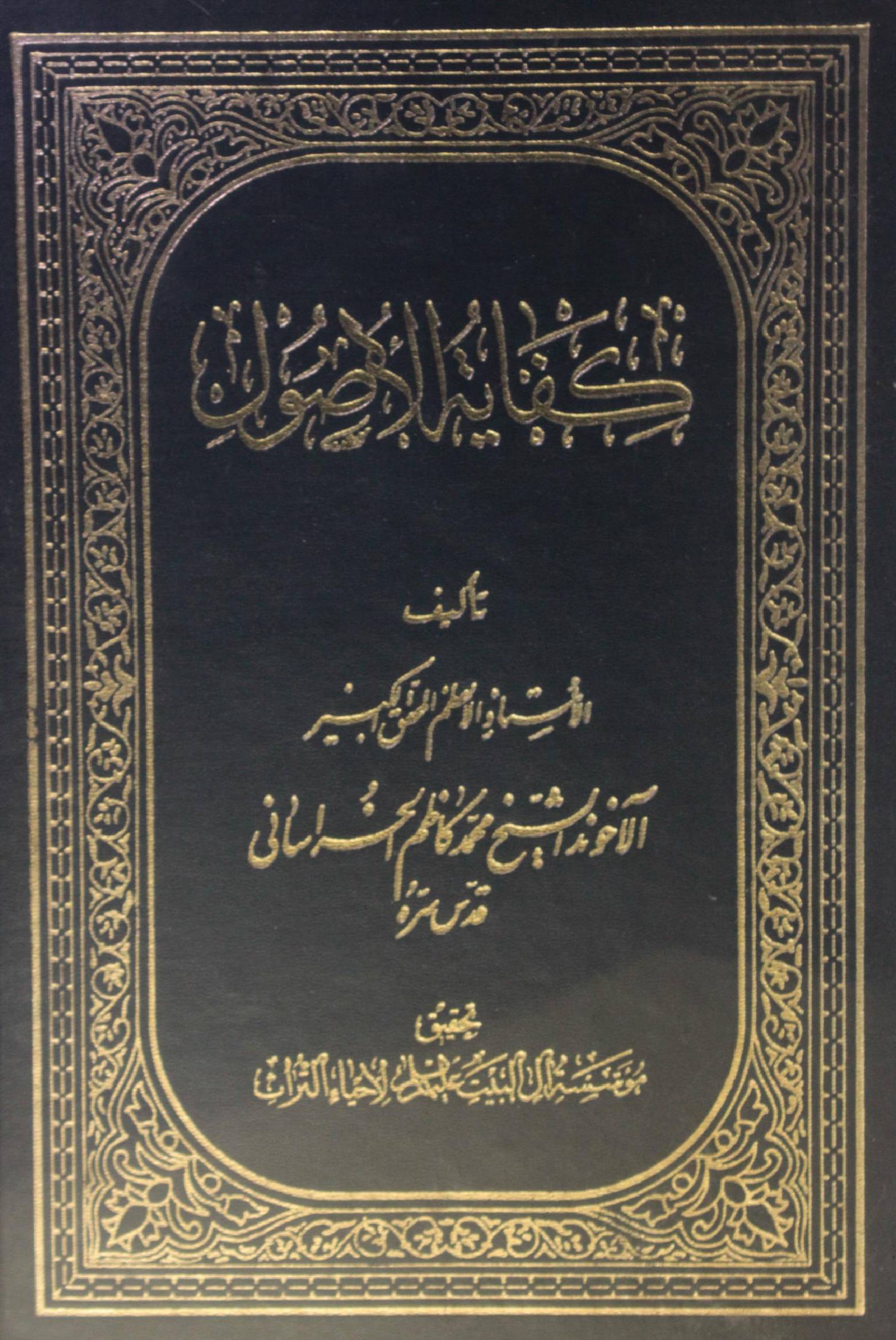
Kifayat al usul
Kifāyat al-uṣūl (Arabic: كفاية الأصول) is a book written by Akhund Khurasani (d. 1329/1911), covering a whole range of issues in the principles of jurisprudence in Arabic. Akhund Khurasani was a student of Mulla Hadi Sabziwari, al-Shaykh al-Ansari, and Mirza Shirazi. He was a Shi'a authority. Kifayat al-usul is a seminary textbook of the principles of jurisprudence, on which many commentaries have been written. Kifayat al-Usul is a comprehensive work on the principles of jurisprudence, covering the latest views up to the author’s time. It consists of an introduction, eight main sections (Maqsad), and an epilogue. Introduction: Covers the nature of disciplines, word meanings, literal vs. figurative usage, and linguistic issues in jurisprudence. First & Second Maqsad: Discusses commands and prohibitions, including their implications in worship and transactions. Third & Fourth Maqsad: Examines implicatures (mafhum) and distinctions between general ('āmm) and specific (khāss) texts. Fifth Maqsad: Analyzes unqualified vs. qualified statements and ambiguous vs. clarified texts. Sixth Maqsad: Explores probabilistic evidence, including certainty, consensus, analogy, and single-narrator reports. Seventh Maqsad: Addresses practical principles like exemption, caution, and continuity. Eighth Maqsad: Discusses conflicts in religious evidence and methods of resolving them. Epilogue: Covers ijtihad (independent reasoning) and taqlid (imitation). This work serves as a foundational text in Islamic jurisprudential methodology.
Published By:
Published Date:
June 15, 2026
Pages:
591
Subjects:
Available Format:
(135.06)
Action:
Description
Kifāyat al-uṣūl (Arabic: كفاية الأصول) is a book written by Akhund Khurasani (d. 1329/1911), covering a whole range of issues in the principles of jurisprudence in Arabic. Akhund Khurasani was a student of Mulla Hadi Sabziwari, al-Shaykh al-Ansari, and Mirza Shirazi. He was a Shi'a authority. Kifayat al-usul is a seminary textbook of the principles of jurisprudence, on which many commentaries have been written. Kifayat al-Usul is a comprehensive work on the principles of jurisprudence, covering the latest views up to the author’s time. It consists of an introduction, eight main sections (Maqsad), and an epilogue. Introduction: Covers the nature of disciplines, word meanings, literal vs. figurative usage, and linguistic issues in jurisprudence. First & Second Maqsad: Discusses commands and prohibitions, including their implications in worship and transactions. Third & Fourth Maqsad: Examines implicatures (mafhum) and distinctions between general ('āmm) and specific (khāss) texts. Fifth Maqsad: Analyzes unqualified vs. qualified statements and ambiguous vs. clarified texts. Sixth Maqsad: Explores probabilistic evidence, including certainty, consensus, analogy, and single-narrator reports. Seventh Maqsad: Addresses practical principles like exemption, caution, and continuity. Eighth Maqsad: Discusses conflicts in religious evidence and methods of resolving them. Epilogue: Covers ijtihad (independent reasoning) and taqlid (imitation). This work serves as a foundational text in Islamic jurisprudential methodology.