

The Fihrist part 2
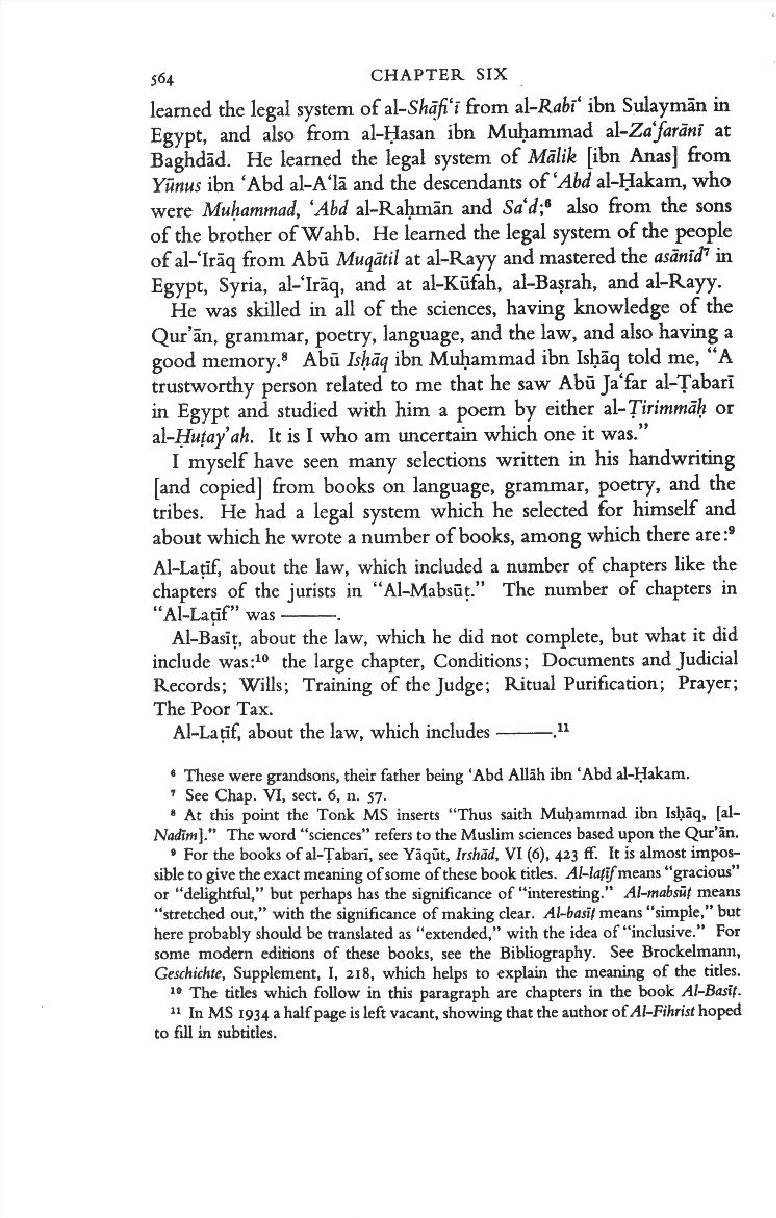
The Kitab al-Fihrist (The Book Catalogue) is a compendium of the knowledge and literature of tenth-century Islam compiled by Ibn al-Nadim, who was a Muslim biographer and bibliographer(d.998). It references approx. 10,000 books and 2,000 authors. This crucial source of medieval Arabic-Islamic literature, informed by various ancient Hellenic and Roman civilizations, preserves from his own hand the names of authors, books and accounts otherwise entirely lost. Al-Fihrist is evidence of Ibn al-Nadim's thirst for knowledge among the exciting sophisticated milieu of Baghdad's intellectual elite. As a record of civilisation transmitted through Muslim culture to the Western world, it provides unique classical material and links to other civilisations. The author's aim, set out in his preface, is to index all books in Arabic, written by Arabs and non Arab authors, as well as their scripts, dealing with various sciences, with accounts of those who composed them and the categories of their authors, together with their relationships, their times of birth, length of life, and times of death, the localities of their cities, their virtues and faults, from the beginning of the formation of science to this our own time. This book is presented in 2 parts and this is part 2 of the series.
Published By:
Published Date:
June 15, 2026
Pages:
586
Subjects:
Available Format:
(106.91)
Action:
Description
The Kitab al-Fihrist (The Book Catalogue) is a compendium of the knowledge and literature of tenth-century Islam compiled by Ibn al-Nadim, who was a Muslim biographer and bibliographer(d.998). It references approx. 10,000 books and 2,000 authors. This crucial source of medieval Arabic-Islamic literature, informed by various ancient Hellenic and Roman civilizations, preserves from his own hand the names of authors, books and accounts otherwise entirely lost. Al-Fihrist is evidence of Ibn al-Nadim's thirst for knowledge among the exciting sophisticated milieu of Baghdad's intellectual elite. As a record of civilisation transmitted through Muslim culture to the Western world, it provides unique classical material and links to other civilisations. The author's aim, set out in his preface, is to index all books in Arabic, written by Arabs and non Arab authors, as well as their scripts, dealing with various sciences, with accounts of those who composed them and the categories of their authors, together with their relationships, their times of birth, length of life, and times of death, the localities of their cities, their virtues and faults, from the beginning of the formation of science to this our own time. This book is presented in 2 parts and this is part 2 of the series.